Why I chose Leica
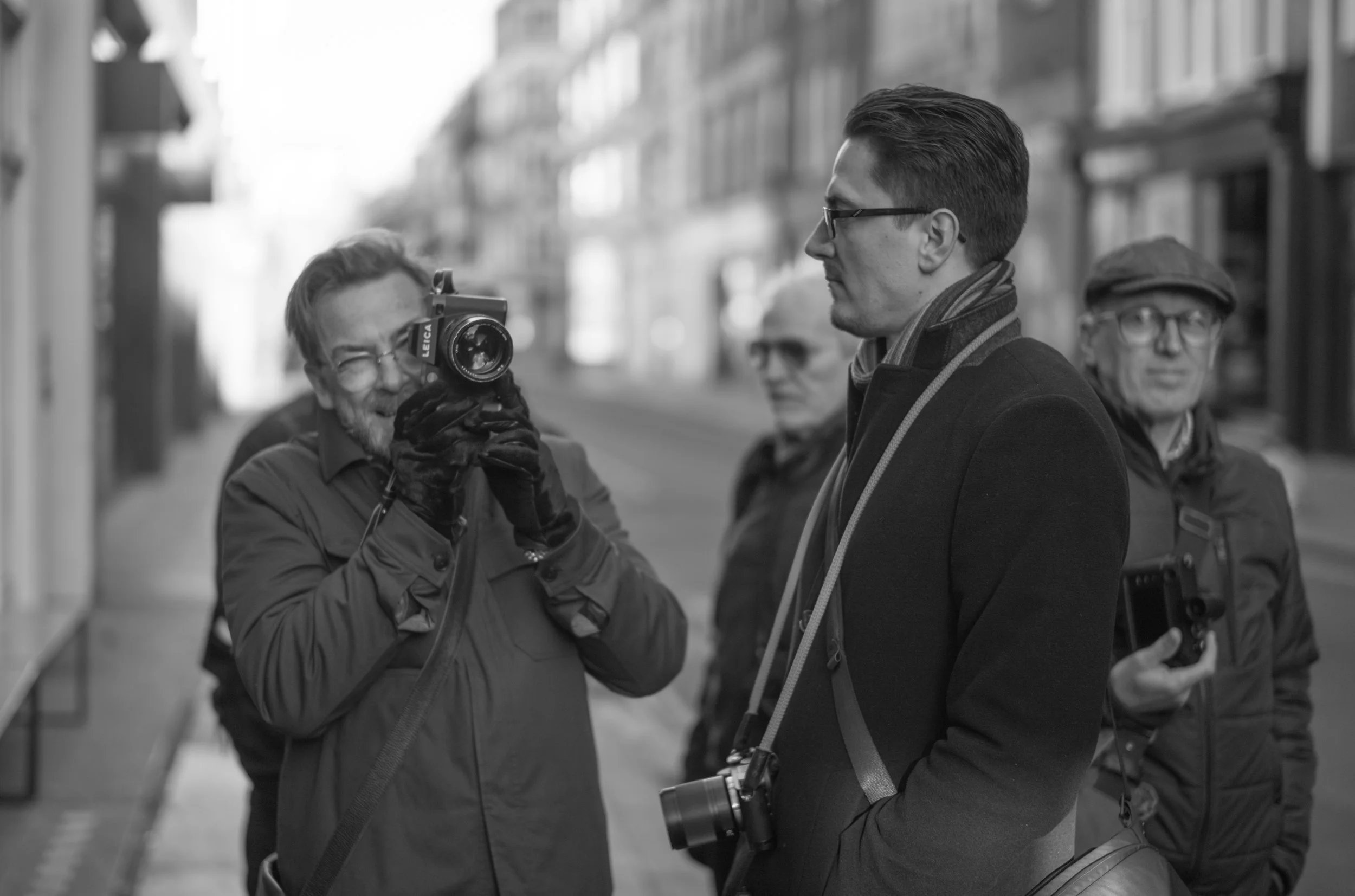
Why I chose Leica…
I remember when I first became interested in photography, I came across the Leica Q. There was something about that camera that struck a cord. It seemed groundbreaking and yet so simple. However, I never followed my instinct at the time and purchased a Sony A7 (something) with a kit lens instead.
I never really understood the Sony. Not because it was a bad camera, actually the opposite. It just occurred as complex and so I only used it as a point and shoot, all in auto mode and all shot on .jpeg. At least it gave me a taste and yet I remained uneducated and less inspired about photography.
I sold that camera when I moved to London in 2019 and then in early 2020, when the world began locking down due to Covid, with time on my hands, I saw the opportunity to explore photography and immerse myself in learning and to practice the skills I acquired through that education.
I started by learning photography on my phone camera. I learned the fundamentals, the basics of framing and composition and making the most of light. I bought external lenses that helped me take some surprisingly good photos with the only camera that was always in my pocket. I even enrolled in a digital photography course and worked my way through some of the early lessons just using my phone camera. It is a digital camera after all.
As I dived deeper into the world of photography, it became clearer for me that I needed to "graduate" to a "real" camera. Two ideas were at play for me: one was that photography was something that was challenging and rewarding; the other was that if I wanted to do it properly I needed serious gear. As I explored further, it also became clear that if I was to get into a camera system, it had to be Leica. Many of the 20th century's most defining images were shot on a Leica!
In my pursuit of finding the right camera for me, I came across Thorsten von Overgaard (Thorsten von Overgaard Lounge) and, in particular, his article of the Leica Q. He had me from his opening lines... "The Leica Q will teach you the art of walking. Good walking shoes is the first important feature of any photographer. A portable camera is the next. You will miss your 90mm lens and your 50mm Noctilux the first days with the Leica Q. Now you got to move your feet and use your head to compose. One lens is all you got. It's brilliant. This is the camera for training of the eye and mind. When people ask me, what camera to get, there is not many to point at. You want a simple camera with very few controls; those few controls should all be on the outside of the camera, not hidden in 250 menus and buttons to get lost in. Few essential controls and nothing more." I was hooked, mesmerised and had to find a well-loved second hand Q.
And so I became a photographer or better said, a passionate enthusiast who takes photographs in the hope that some day, just maybe, I will produce an image that is really, truly memorable.
When I finally found my Q, I was not expecting the weight and feel of that camera. I was holding a silver-black metallic object that was beautiful, simple in design and so Bauhaus. "It's a Leica," the person said. "It's made in Germany."
The Leica Q camera of today was invented over 100 years ago in Wetzlar, a small town in Germany, where a 35-year-old technician invented a camera that would shape the way we perceived the world for the rest of the 20th century.
His name was Oskar Barnack, and he worked for a company called Leitz which made microscopes for scientific research. He had been hired by Ernst Leitz, the proprietor of the company, in 1911 and by 1913 had risen to be its director of research and development. His abiding passion, however, was not microscopy but photography, an art form that at that time required not just technical skill but a physique strong enough to lug around a large plate camera and its load of 16.5cm x 21.6cm glass plates.
Barnack suffered from acute asthma and the weight of the kit caused him difficulty in breathing, so he set out to reduce the load. He first tried fitting four images on to a single glass plate, but abandoned that approach because the quality of the images was poor. (At that time photographic prints were mostly produced by contact printing from the negative and so quality was directly proportional to the size of the negative: the bigger the glass plate, the better the result). Barnack concluded that lightweight photography would have to be done with something less dense than glass plates, and with smaller, lighter, cameras.
At this point, he had a stroke of luck. One of his colleagues, Emil Mechau, was working on a project to improve the performance of movie projectors, particularly the infuriating fluttering of the images when projected on to a screen. He was working with 35mm celluloid roll film – a format invented by Thomas Edison in the 1890s which eventually had become standard for the emerging motion-picture industry. Barnack had found the lightweight recording medium he sought. All that was needed was a camera that could handle it.
Barnack set about designing and building one. The prototype he came up with was made of metal (hitherto cameras were hand-built, often exquisitely, with hardwood). The camera took one picture at a time, the film being wound on manually by means of a sprocket wheel that engaged with the holes on the sides of the film strip. Because the film moved horizontally, rather than vertically as in a movie camera, he decided that the dimensions of each image should be 36 x 24mm, and that a roll of 36 images would fit in the camera body.
Thus were set the basic parameters of 35mm photography. There remained, however, one problem. Since the 36 x 24 images were tiny by the standards of the day, the only way to produce large images of acceptable quality would be to print them via an enlarger. The tiny images would have to be phenomenally sharp, which meant that they needed lenses of extraordinary optical quality. Here again Barnack was lucky. One of his colleagues at Leitz was a genius with optics named Max Berek, who designed a 50mm lens (the first Elmar) that delivered the kind of optical performance Barnack's camera needed.
The first three prototypes of the camera were produced in late 1913 and early 1914. It was called the Ur-Leica (Lei from "Leitz" and Ca from "camera"). It was astonishingly small, fitting comfortably into one's hand, had a two-speed shutter, an automatic frame-counter and Berek's f3.5 Elmar lens (which collapsed into itself when not in use, making the camera even more compact). It was a breathtaking, revolutionary device that would change photography for ever.
One of the first photographs Barnack took with the camera shows a spike-helmeted German soldier who has just affixed to a public building a copy of the Emperor's Order for total mobilisation. Germany, along with the rest of Europe, was descending into the First World War.
Leitz survived the war and the ensuing depression. The first commercial Leica – the Leica I – was launched at the Leipzig Fair in 1925. It was already much more sophisticated than the prototypes. It had a built-in optical viewfinder, shutter speeds ranging from 1/20th to 1/500th of a second, an accessory shoe and Berek's Elmar lens. Just under 59,000 of the Leica I were made and those that survive are now among the photographic world's most coveted collectibles. Five years later, the first Leica with interchangeable lenses was introduced. The revolution was under way. Suddenly it was possible to be unobtrusive. The camera fitted in a coat pocket. It didn't need a tripod and was quick and quiet to operate. So photography became fluid, informal, intimate: the technology no longer got in the way of telling the story. So new kinds of storytelling evolved, published in the new illustrated magazines such as Picture Post and Life. At the heart of photojournalism was the Leica. Almost all the great photojournalists of the period had at least one of them in his or her bag.
Leicas have never been cheap but when you handle one you can see why. They are beautifully engineered precision instruments. They have a reassuring heft and solidity, and shutter actions that are exquisitely balanced and quiet. And they go on for ever and Leitz will fix and service them if they falter. Until the early 1970s the cameras contained no electronics, not even an exposure meter, which meant they were astonishingly robust.
Leitz lenses are astonishingly good in terms of sharpness, resolution and colour rendition. The top-end Noctilux f/0.95 50mm lens, for example, is capable of admitting more light than most lenses in the world. But at over £10,000 it can also deplete your bank account faster than you can click your shutter.
I bought my Leicas, digital and analogue, not for the prestige of the red dot but because they continue to teach me everything about photography. They force me to think about ways of seeing rather than merely taking shots. If I fail in my quest for the perfect picture then I only have myself to blame and tomorrow is another day…
“You don’t make a photograph just with a camera. You bring to the act of photography all the pictures you have seen, the books you have read, the music you have heard, the people you have loved.”
~ Ansel Adams