A Thoroughly Delightful Medium Format Film Camera...

A Thoroughly Delightful Medium Format Film Camera...
I’ve been wanting a 120mm film camera from the time I started to dive into the world of film. I romanticised about taking photos Vivian Meier style using a Rollieflex camera and, as a Christmas present last year, my wife and I bought a Rollieflex New Standard for our personal work, that was in very good condition. Or so we thought... Putting through 2 rolls of film... Porta 160 and Kentmere 400... we discovered that the camera had an issue with focus... Every single photograph was blurry and fuzzy, the colours and tones muted and there were uniform scratch marks throughout both films. Gratefully, the seller refunded our purchase and we sent it back, a little less enthusiastic about a Rollieflex, but still determined to explore medium format film.
Most medium format cameras have a size and weight to them that can be unwieldy and cumbersome to carry for a whole day out, so I wanted something that was relatively compact and lightweight, easy to use that would take sharp images bringing the best from the higher resolution of 120 mm film.
I came across the FujiFilm GA645i 6×4.5 medium format, rangefinder style camera. These are my thoughts on the camera and as you may have gleaned by the title of this blog... I am delighted.
All my cameras are Leica, apart from a Kodak half-frame (I’ll write a blog on this next) and a Polaroid Now+.... A collection of shooters from classic rangefinders to inexpensive-but-fun point and shoots. I love them as much for their looks as I do their abilities.
I shoot both digital and film. I love both formats for what they bring to the medium of photography. I look for cameras that seem to bring form and function together in unique ways.
Now when I look at FujiFilm cameras, FujiFilm have experimented with their lines, creating niche markets and designing cameras to test what is possible. Looking at their creations, past and present, they have a knack of producing cult cameras.
I love manual cameras, but I like a bit of automation too. My primary cameras are the Leica M11 and the Leica SL2, both are cameras with aperture priority and both can be used full manual.
After trying out the Rollieflex, I wanted a 120mm camera with a bit of heft in the hand, like my Leicas; one that was simple to use, compact and quiet but always gave beautiful results, with a good viewfinder.
Plunging into the world of medium format, the Mamiya 645 Pro TL was one of the standouts with a great reputation. However, it’s not the best medium format for street photography, which is a passion of mine. It’s heavy, noisy and rather imposing. People can get put off by a massive camera and I realised that I needed something that gave me the quality of medium format, but with the compact form and automation of a point and shoot.
This singular thought helped to focus my search, and after much advice from a whole range of camera forums, YouTube videos and camera reviews, I bought a mint condition Fuji GA645i.
The Fujifilm GA645i was made by FujiFilm in 1997, as the successor to the GA645. The difference between the two, as far as I’m aware, is that the “i” has an additional shutter release button on the face (a really good addition), and it may be a little quieter/ faster to focus than the original, according to the sources I have read.
The Fuji GA645i is lightweight for a medium format camera weighing in at just over 815 grams. It’s also compact for a medium format camera measuring 166mm wide, 110mm high, and 66mm deep when turned off. When turned on and the lens is extended its depth becomes 84mm. Its body is made of hard plastic (though it feels as sturdy as their magnesium body cameras) with a grip that houses the batteries making it a comfortable camera to hold.
The GA645i has a 60mm f/4 lens with a minimum focal distance of 70cm. (There is also a version with a zoom lens, the GA645zî 55-90mm). The shutter is electronically controlled with speeds from 2 secs to 1/700 sec. The camera has Programmed auto, Aperture priority and Manual modes. It has a self-timer with 10-second delay. The camera can print a whole variety of shot info on the edges of the negatives – analogue EXIF data, so to speak. The camera is approximately 16 cm long, 11cm tall and 6cm deep. There is a pop-up flash in the centre, and also a hotshoe for external flash. Both strap lugs are on the left hand side of the camera.
The film camera is incredibly simple to load: the roll goes in the back, you pull it across to feed into the empty roll, and when you turn the top dial, it automatically takes up the slack and sets you up for the first shot. Compared to the Rollieflex, which was fairly straightforward, this makes it so easy to shoot with medium format. And you get 16 shots per roll. A bonus. You set the film speed by clicking to the ISO selector on the rear dial and turning the top dial to choose your setting. FujiFilm has made an incredibly intuitive medium format camera.
The GA645i’s rangefinder is oriented in portrait, unlike most other cameras which are oriented in landscape. This is something I quickly adapted to. And it is ideal for those who shoot portraits; with the GA645i you just point and shoot. When you focus on a subject, the framelines move in and out to show the area that the frame will cover, and a digital display shows the aperture setting, shutter speed and subject distance, in that order, along the bottom of the display. By half pressing the shutter button you can lock focus and then reframe, fully depressing the button to take a shot.
The GA645i begs you to pick it up and just get shooting. In fact, it’s easy to forget that you’re shooting with medium format, and you can burn through a roll of film very quickly because it’s fun to use.
The noise that this camera makes when focusing has received some attention, but in my view, it isn’t an issue at all. It makes a bit of a mechanical sound when the lens moves in and out to find its focus but I like it. I recently went on a coastal photoshoot in Suffolk with Jason Avery, a black and white film only photographer, who was shooting with a Leica M-P. He had never seen this camera before and when I took a couple of portraits of him, his comment was, “that sounds pretty quiet.”
It is an easy camera to shove in a bag or have around your neck all day without any problem. It is rare for any medium format autofocus camera to be able to easily carried with you every day. It is not pocket-sized, but small enough not to get in the way.
This camera has a “Super– EBC Fujinon F/1:4 60mm lens” according to the writing on the front of it. F/4 may not sound very fast, but this is a medium format camera, and once you see the results you won’t mind at all because it is super sharp, and renders beautiful images.
The 60mm lens equates to roughly a 35mm lens on a 35mm camera, so very useful for street, portraits and landscapes. The image quality is stunning. They photos are crisp, natural and full of detail. Using the flash works well, filling just enough without looking too harsh. It’s not powerful enough to really light up a very dark scene, but the hot shoe is there if you want to add more light.
The autofocus is fast, but not super fast by modern day standards. Fast moving objects may be challenging but it is not designed for that kind of photography anyway. If you want to capture a superb portrait or a magnificent landscape, it works really well. You can also manually focus the camera, by setting the distance using the top dial.
My favourite film stocks so far with this camera has been Kodak Portra 400 and Ilford FP4Plus and I think this camera will bring out the best of any film used.
This camera is just a joy to use. The FujiFilm GA645i is light, easy to use, with consistent good results.
Though this camera was made 20 years ago, if you find one in good condition it should last a while. It’s also quick to use; the clue is in the name- point… and shoot. Done. Picture taken, on to the next shot. It’s easy to take out. This is really important- there’s nothing sadder than a wonderful camera that isn’t used as the result of some quirk in its design that stops it from being an everyday shooter. This camera begs to be used because of its great design and its great results. Simplicity of use and professional in its results with cracking looks. A cult camera in the making, if not already...
“The world just does not fit conveniently into the format of a 35mm camera."
~ W. Eugene Smith
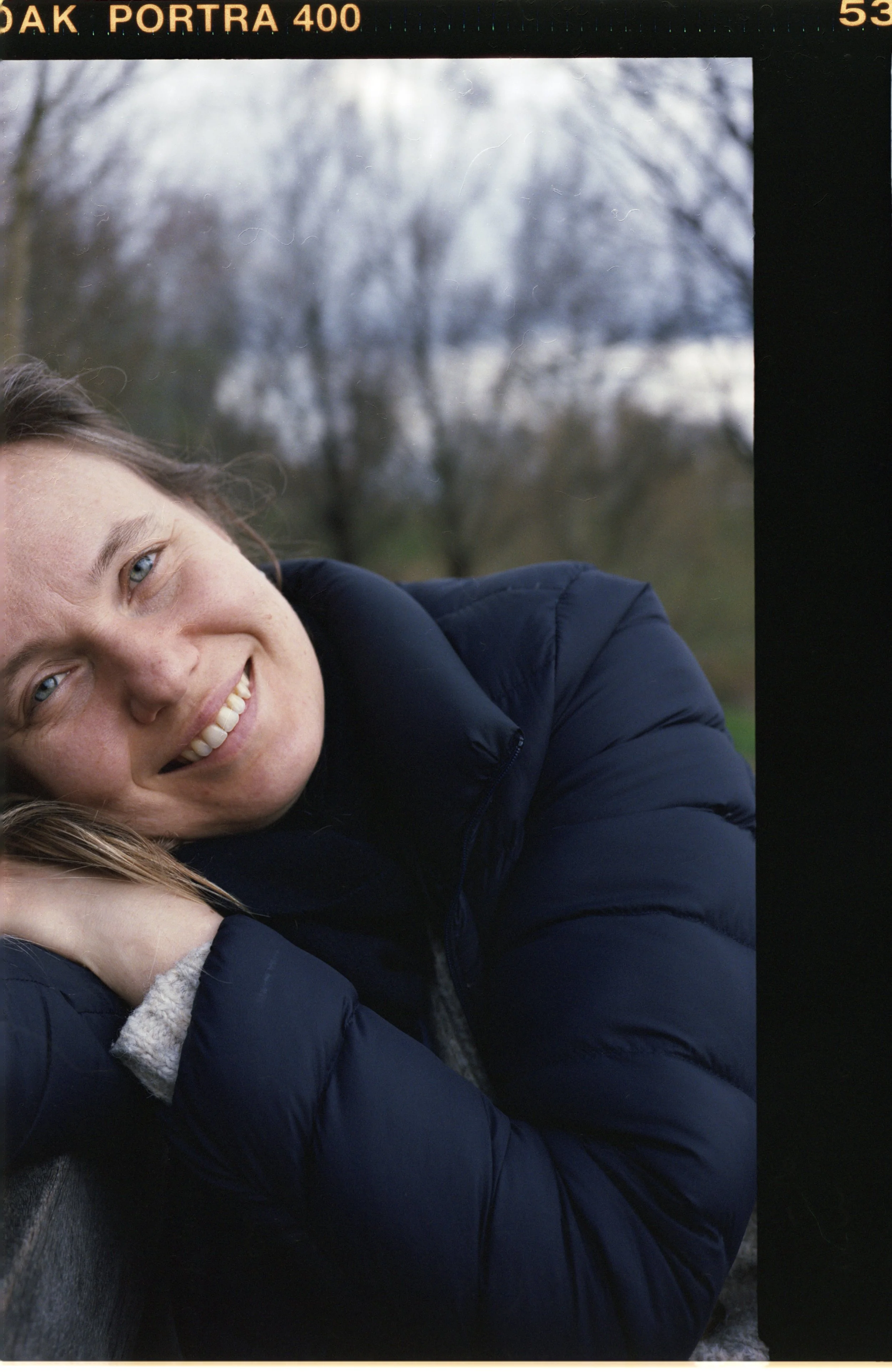
FujiFilm GA645 / Kodak Portra 400